
Creativity and cognitive work rarely follow a straight line. Some days, ideas flow effortlessly and complex problems untangle quickly. Other days, even simple tasks feel heavy, and focus slips away. While discipline and time management matter, they do not operate in a vacuum. Your brain and body run on predictable biological rhythms that influence mental energy, problem-solving speed, and creative inspiration. By learning to read these cycles, you can identify when to push forward, when to step back, and how to structure your work around your natural peaks and troughs. This guide covers the practical side of applying biorhythms through Biorhythms Calculator to support your thinking process, highlighting both the opportunities your cycles present and the threats to watch for.
Cognitive Triad & Intuitive Patterns
Creative and analytical work is rarely driven by a single rhythm. Instead, it emerges from the interplay of three primary cycles:
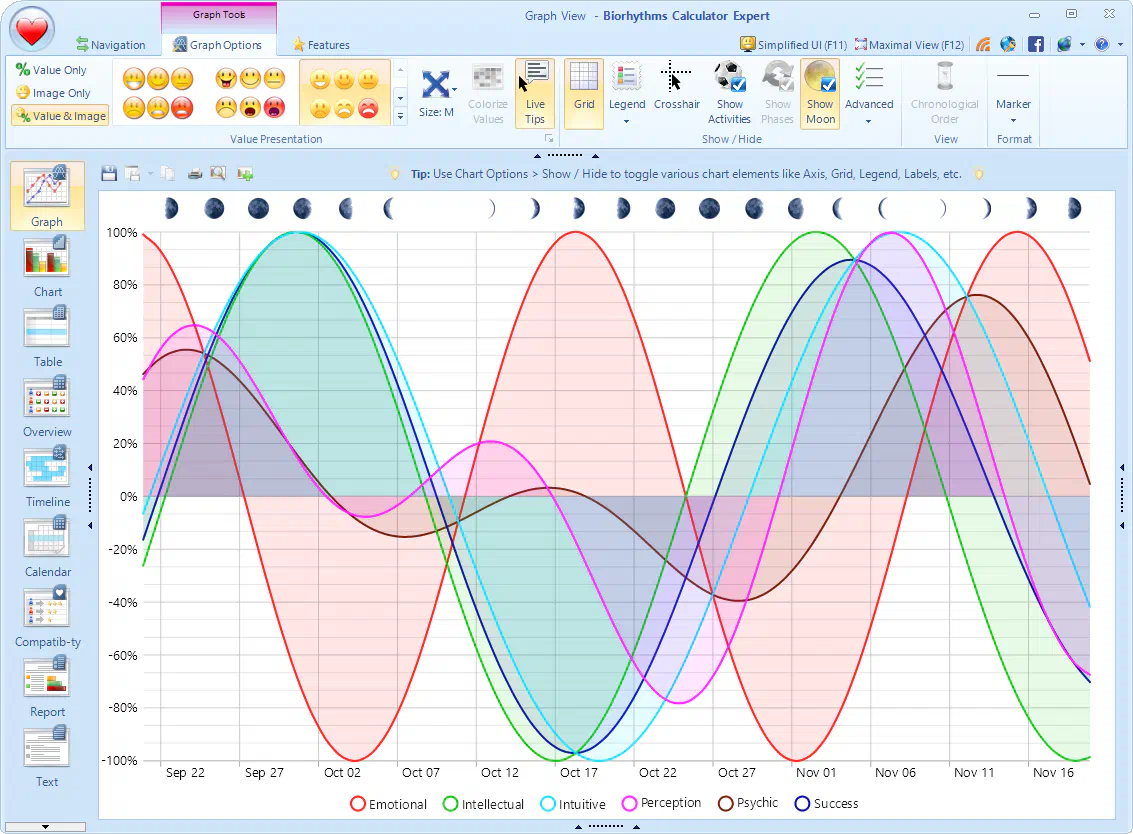
- Intellectual Cycle (33 days): Governs logical analysis, memory, accuracy, learning, and structured problem-solving. Highs favor quick-fire intellect and sharp concentration.
- Emotional Cycle (28 days): Influences mood, motivation, sensitivity, and openness to new ideas. Highs bring optimism and emotional resilience; lows bring introspection and caution.
- Intuitive Cycle (38 days): Controls perception, pattern recognition, subconscious insights, and creative inspiration. Highs are ideal for ideation; lows are better for structuring and refining.
Beyond these, there are Intuitive Pattern Rhythms, which blend the Intuitive cycle with other primary cycles to create hybrid rhythms tailored to creative-cognitive work:
- Perception Cycle (Physical + Intuitive): Combines physical stamina with intuition. Ideal for hands-on creative work, sustained ideation sessions, or tasks requiring both mental and physical endurance.
- Psychic Cycle (Emotional + Intuitive): Merges mood and intuition. Often linked to emotional resonance, artistic expression, and empathetic creativity.
- Success Cycle (Intellectual + Intuitive): Combines logic and intuition. Perfect for innovative problem-solving, strategic thinking, and those sudden `aha` moments where analysis meets inspiration.
Visualize how these cycles interact by viewing them together in the main graph in Biorhythms Calculator. Overlaying the primary rhythms with their Intuitive Pattern combinations reveals hidden windows where creativity and logic align.
Mapping Opportunities and Threats for Creative Work
Understanding your cycles is less about predicting the future and more about preparing for the present. Each phase offers distinct advantages and challenges.
Opportunities (Positive Phases):
- Intellectual peaks: Ideal for deep work, writing, data analysis, and structured learning.
- Intuitive peaks: Prime windows for brainstorming, concept development, and creative leaps.
- Emotional peaks: Boost motivation, collaboration readiness, and willingness to take creative risks.
Threats (Negative Phases & Critical Days):
- Passive phases: Mental energy dips, slower processing, and reduced tolerance for complex tasks.
- Critical days: Transitional periods where concentration, memory, and emotional stability are temporarily impaired. These are the most vulnerable times for typos, misjudgments, or creative blocks.
- Zero days: The reverse transition (passive to active). While not as taxing as critical days, they still require gentle pacing as your system adjusts.
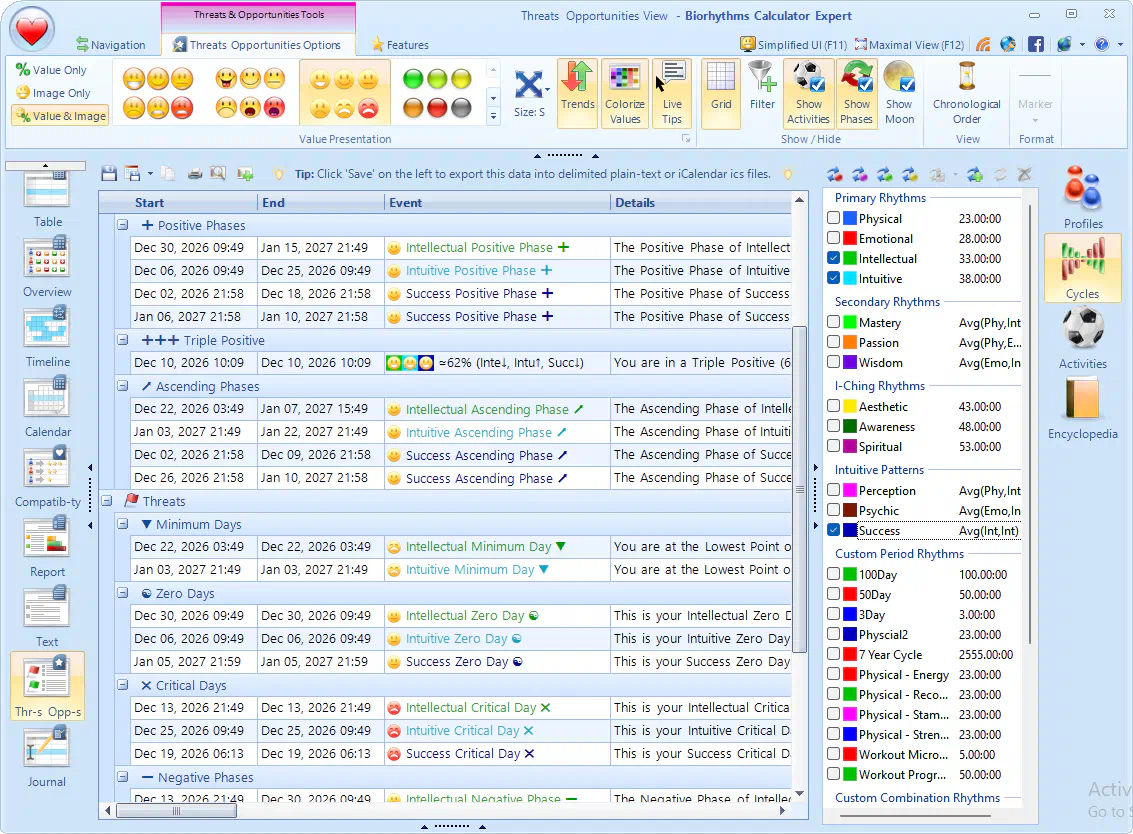
Use Biorhythms Calculator's Threats & Opportunities view to spot these shifts at a glance. It clearly marks positive phases where you can push forward, and critical zones where you might want to schedule buffer time or lighter tasks.
Even if you are new to reading these transitions, various cycle periods and key moments are all clearly marked in the various views available in Biorhythms Calculator making it easier to understand your biorhythmic well-being at a glance.
Scheduling Deep Focus vs. Open Brainstorming
Structured analysis and free-form ideation often require different mental states. When your Intellectual cycle is in a positive phase, your brain is naturally primed for logical reasoning, memory recall, and methodical problem-solving. This is the ideal window for deep focus tasks like solving complex issues, drafting technical documentation, or crunching data. Conversely, your Intuitive cycle drives pattern recognition, subconscious insights, and creative leaps. During an Intuitive peak, you are more likely to experience sudden "Aha" moments and make unconventional connections that structured thinking might miss.
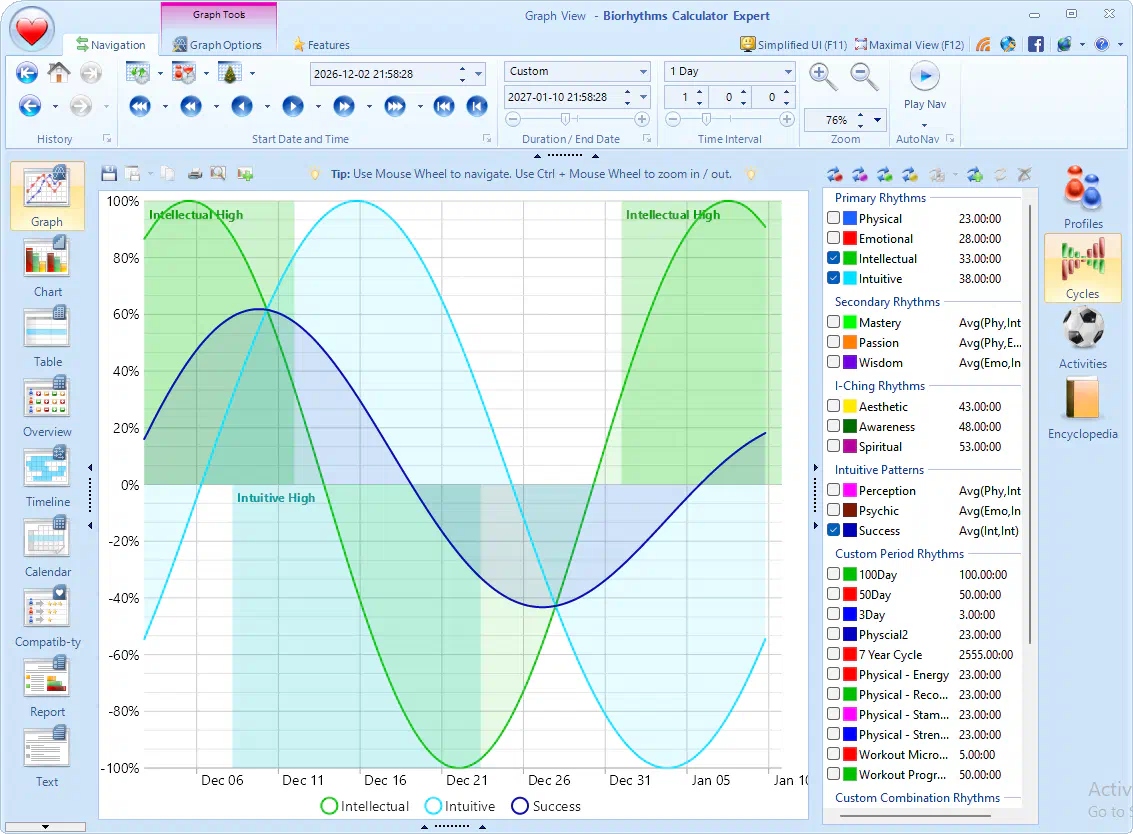
The friction often comes from forcing the wrong type of work during the wrong phase. Trying to push through deep analytical work while your Intuitive cycle is in a passive phase can feel like rowing against the current, leading to mental fatigue without proportional output. Instead, align your calendar with your biorhythms: reserve high-energy windows for structured focus when your Intellectual rhythm is strong, and save low-pressure periods for open brainstorming when your Intuitive rhythm is climbing.
View your cycles side by side to spot where intellectual peaks and intuitive peaks align or diverge. Biorhythms Calculator makes it easy to spot dedicated focus hours and creative exploration windows without guesswork.
Tip If you want to customize which cycles are visible or adjust their colors to match your workflow, you can easily toggle them in the main window.
Avoiding Critical Days for High-Stakes Decisions
Critical days occur when a cycle crosses the zero line, marking a transition from a positive to a negative phase (or vice versa). During these transitional windows, your body and mind are actively adjusting to the shift, which temporarily impairs concentration, memory retention, and emotional stability. While a critical day does not guarantee failure, it does shrink your margin for error. Small oversights that would normally be caught may slip through, and misinterpretations are more likely during sensitive conversations or contract reviews.
The most practical approach is to treat critical days as buffer zones rather than dead zones. Schedule routine tasks, administrative work, or light reading during these periods, and hold off on high-stakes decisions, final edits, or important presentations until your cycles stabilize. If a deadline falls on a critical day, build in extra review time or ask a colleague for a second pair of eyes to catch potential mistakes.
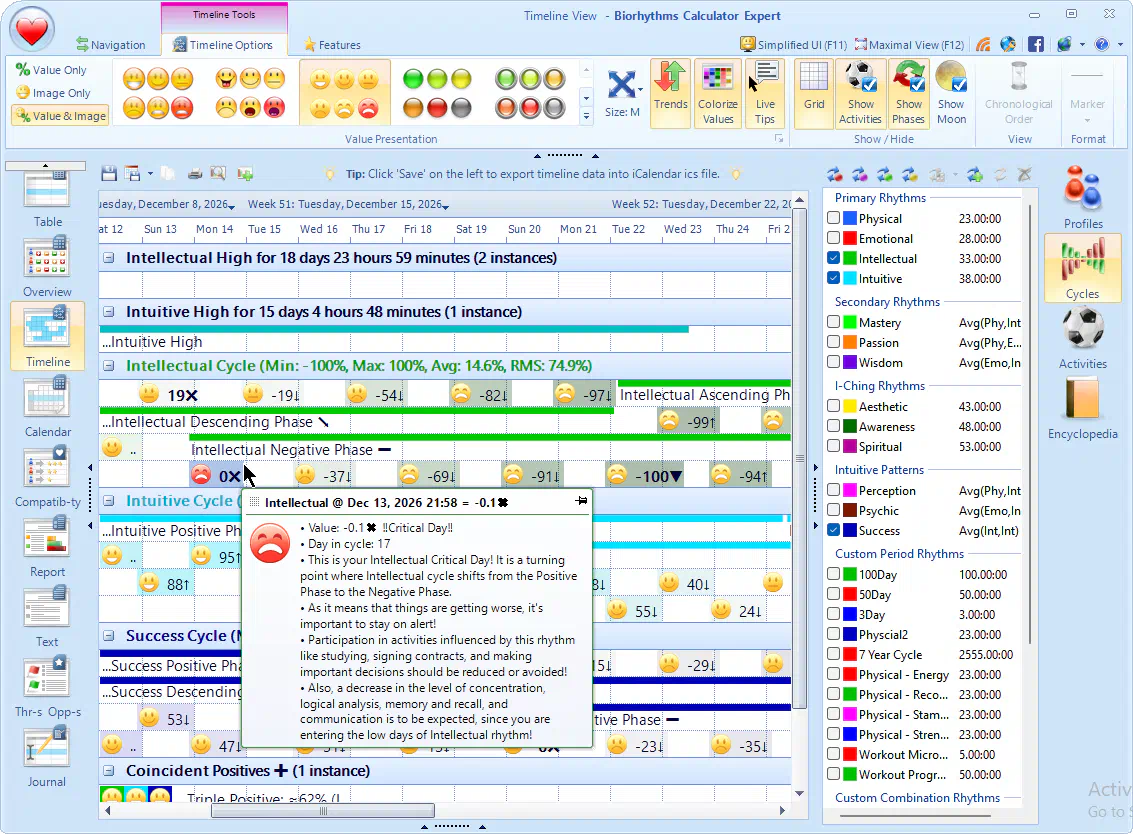
The Timeline View clearly marks critical and zero days with distinct visual indicators. You can quickly spot vulnerable periods and shift heavy deadlines to adjacent stable days.
Blending Cycles for Hybrid Tasks
Real-world creative work rarely relies on a single rhythm. Hybrid tasks like innovative problem-solving, strategic planning, or cross-disciplinary design often require both analytical rigor and creative intuition. Biorhythms Calculator makes this alignment effortless through Intuitive Pattern Rhythms, which mathematically combine the Intuitive cycle with other primary rhythms. The Success Cycle, for example, blends the Intellectual and Intuitive cycles to highlight windows where logical structure meets creative insight. The Perception Cycle merges Physical stamina with intuition, making it ideal for hands-on creative projects that demand both creativity and physical endurance.
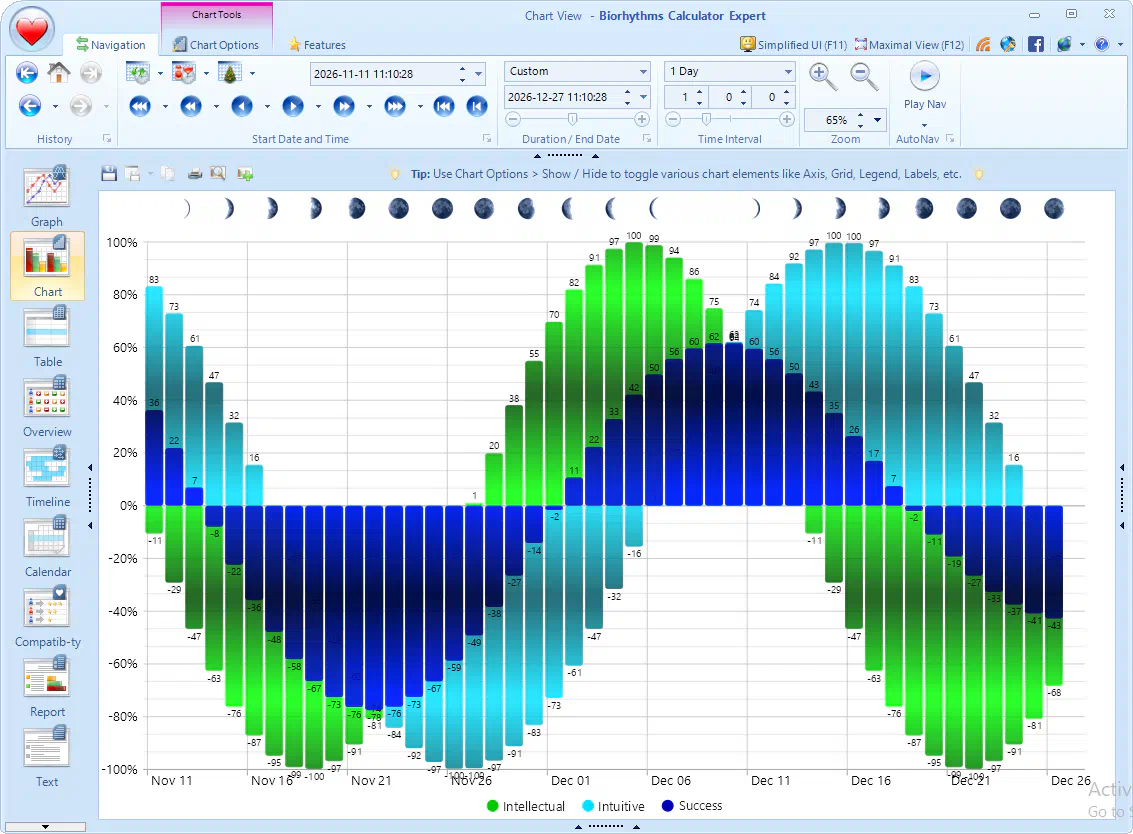
Instead of waiting for two separate primary cycles to peak simultaneously, you can track these hybrid rhythms to find smoother, more consistent windows for complex work. When the Success Cycle climbs, you are likely to experience clearer strategic thinking and faster breakthroughs. When the Perception Cycle rises, you will have the sustained energy needed to execute creative concepts from start to finish.
Watch how the combination Success cycle emerges from the interaction of Intellectual and Intuitive primary rhythms. The chart automatically calculates and displays hybrid peaks, giving you a clearer picture of when analytical and creative forces align.
Tip If you want to customize which hybrid rhythms appear on your chart or adjust their display order, the interface makes it simple to tailor the visualization to your workflow.
Tip Biorhythms Calculator lets you create your own custom combination cycles to produce hybrid rhythms that matter most to your projects.
Turn Passive Phases into Productive Windows
Passive phases occur when a cycle dips below the zero line, signaling a period of reduced energy, slower processing, and lower tolerance for complex tasks. Many creatives and knowledge workers mistake this natural dip for a lack of discipline and force heavy output during low-energy windows, leading to burnout or diminished quality. In reality, passive phases can be highly valuable when matched with the right type of work. They are excellent for editing, formatting, organizing files, reviewing past drafts, or clearing administrative backlogs.
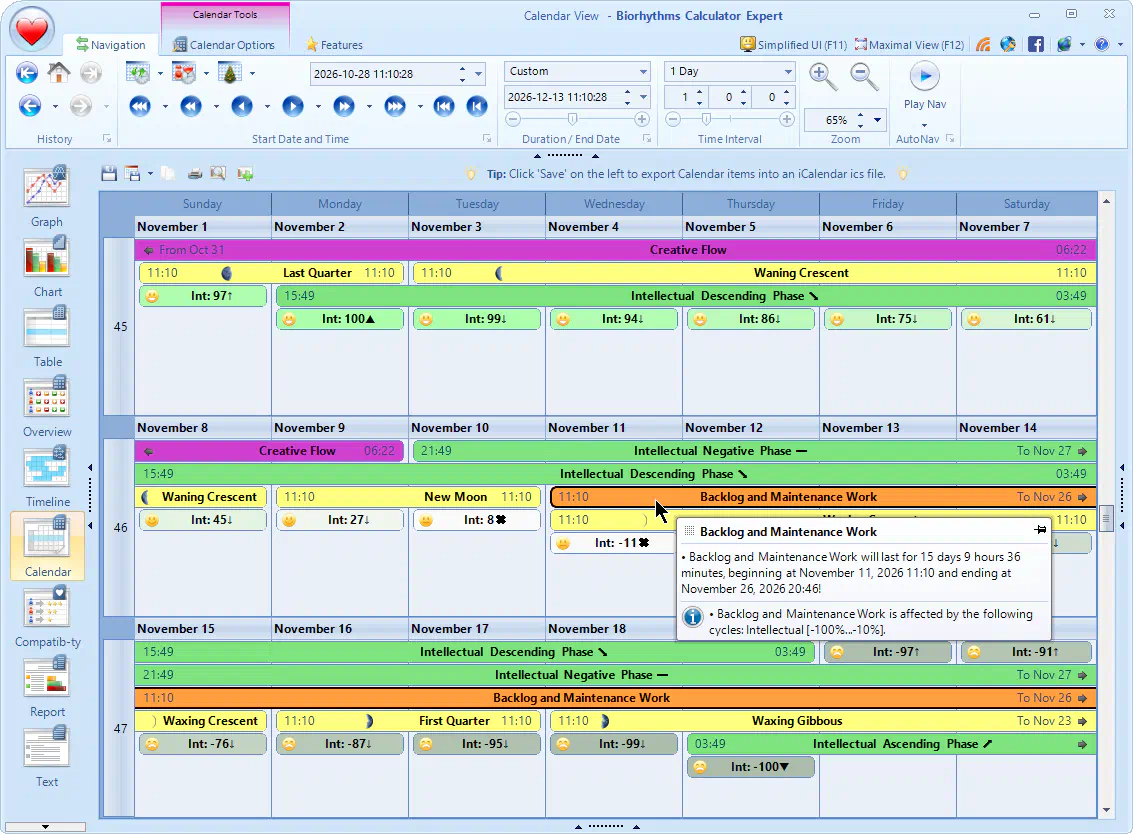
The key is to stop fighting the rhythm and start working with it. Use passive windows for tasks that require patience and attention to detail rather than rapid innovation. In Biorhythms Calculator you can easily set up threshold-based Activities that automatically flag these periods as `Backlog and Maintenance Work` blocks for example, so your calendar reflects your biological reality instead of fighting against it.
See how on the screenshot passive phases naturally align with backlog and maintenance tasks. Biorhythms Calculator lets you map these low-energy windows to specific workflow stages, which you can easily export to your favorite calendaring app in iCal format, thus ensuring you never force heavy creation when your mind needs a lighter touch.
Tip To automate how your calendar reflects these natural energy shifts, you can define custom Activities that trigger based on your cycle thresholds.
Tracking Real-World Output with the Journal

Biorhythm predictions are most powerful when validated against real-world results. The Journal feature lets you manually log your daily focus levels, creative breakthroughs, mental fatigue, and actual output quality. Each entry captures the predicted cycle value alongside your perceived real value, giving you a direct comparison between biological expectations and lived experience. Over time, this data reveals personal patterns that generic cycle charts cannot capture, such as how sleep quality, workload, or stress levels interact with your rhythms.
Because the Journal is tied to individual profiles, you can maintain separate tracking logs for different projects, work modes, or even family members. When you have enough data, you can export your journal entries to CSV or Excel for deeper analysis, allowing you to refine your threshold settings, adjust your scheduling habits, and build a highly personalized rhythm map.
Log your daily experience directly in the Journal view. The interface clearly displays predicted values, real values, and free-text notes, making it easy to spot trends and adjust your workflow over time.
Tip If you want to dive into your journal data outside Biorhythms Calculator, you can easily export your entries for sharing, detailed analysis in spreadsheet software, or archiving for long-term tracking.
The Rhythm of Creation
Structuring your personal workflow to effectively complete a creative project involves moving through distinct stages: ideation, development, and refinement. Aligning each stage with your cycles reduces friction and improves consistency.
- Ideation Phase: Lean on Intuitive and Emotional peaks. This is where you generate concepts, explore possibilities, and embrace unconventional thinking.
- Development & Execution Phase: Shift focus to the Intellectual cycle for structure, but do not overlook the Physical cycle. While the Intellectual rhythm drives the thinking, the Physical cycle (23 days) provides the stamina required to execute. Both should ideally be positive during this phase. Pushing through a Physical low while attempting heavy execution often leads to burnout or sloppy work.
- Refinement Phase: Use steady Emotional and Intellectual states for editing, feedback integration, and final polishing. Critical days are best avoided here, as small oversights can slip through.

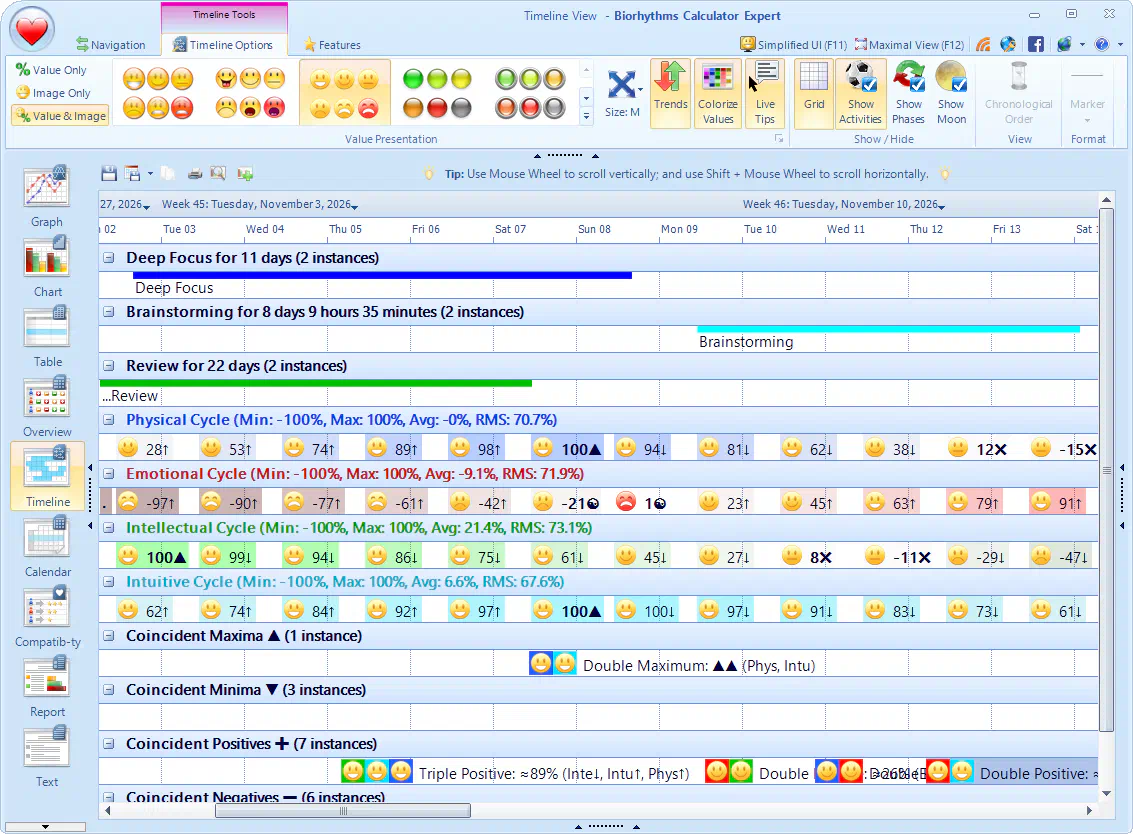
You can automate much of this alignment using Activities & Thresholds. Define tasks like Deep Focus, Brainstorming Session, or Review, then set cycle thresholds to trigger them. For example:
- Deep Focus requires high mental acuity and physical energy:
Intellectual > 40%+Physical > 30%. - Brainstorming Session that leans heavily into your intuitive side:
Intuitive > 50%+Emotional > 20%. - Review that needs a calm mood for a thorough and unbiased review:
Emotional < 20%.
Tip Export a series of these activities as one-time calendar events in iCal format to keep your biorhythm map visible in your daily planner app.
Tip Use the Journal to manually log daily output, mood, and focus, then export reports to spot long-term patterns and adjust thresholds over time.
Quick Reference: Cycle Mapping for Creative Work
| Cycle | Length | Best For | Use Caution During |
|---|---|---|---|
| Intellectual | 33 days | Deep work, analysis, learning | Critical days (accuracy drops) |
| Intuitive | 38 days | Ideation, pattern recognition, creative leaps | Passive phase (structure/refinement works better) |
| Emotional | 28 days | Motivation, collaboration readiness, risk-taking | Critical days (miscommunication, sensitivity) |
| Physical | 23 days | Execution stamina, sustained effort, hands-on tasks | Critical days (fatigue, accident-prone) |
Biorhythms won't rewire your mental habits, but they can help you align your tasks with your natural energy peaks. By recognizing your mental peaks, troughs, and transitional days, you can reduce friction, protect your focus, and create more consistently. Treat these rhythms as a compass rather than a rule-book, and adjust your schedule to match your natural energy.
Now that you have a clear understanding of biorhythm-aware planning, let Biorhythms Calculator map your cycles, and start aligning your best thinking with your biology!
